Tamarind Tree 'Tart'
📍 Available for pickup in Loxahatchee, FL / South Florida delivery only
Tamarind Tree 'Tart' - 3 Gallon is backordered and will ship as soon as it is back in stock.
Couldn't load pickup availability
Fruit Tree Pot Size Reference Guide
Fruit Tree Pot Size Reference Guide
Display general product information or specific product information using metafields.
We sell grafted fruit trees in various sizes, ranging from young 3-gallon plants all the way up to 25-gallon and larger, mature trees.
As a general rule of thumb, here’s what you can expect from each size:
3 gallon: Will take an average of 2-3 years before harvesting your first crop. Trees are small and may be just a single stem, or just starting to develop their first branches. Typical height is between 2-4 feet.
7 gallon: Will take an average of 1–2 years to produce a crop. Branching structure has started to develop, and trunks are between ½ to 1 inch thick. Typical height is between 3-6 feet.
15 gallon: You can usually expect fruit within a year of planting, and some trees are already fruiting at this size. Branch and canopy structure has taken shape and the tree is starting to grow wider. Trunks are between 1 to 1-½ inches thick. Typical height is 5-8 feet.
25 gallon and larger: These are mature trees, and most are ready to produce fruit or have already produced. They have been pruned and shaped multiple times at this point. Trunks are about 2” thick or larger. Typical height is 6-10 ft.
PLEASE NOTE: These descriptions are generalized - Some species of fruit trees are very quick to produce, and others take longer. For example, mulberry trees can start fruiting at a very young age, even as small as a 3 gallon. Mango, avocado, or sapodilla trees will take longer. Each species grows at a different rate and will take varying lengths of time to establish, and even different cultivars can be more precocious (quick to produce) than others.
Order Pick Up/Delivery Info
Order Pick Up/Delivery Info
When you select the “Nursery Pickup” option at checkout, please allow up to 24-48 hours for your order to be prepared for pickup. Once your order is ready for pickup, we will email you to let you know that it is ready. Plant orders may be held at the nursery for up to 10 days. If orders are not picked up within this time frame, a 15% restocking fee will be charged. If you are unable to pick up your order, please contact us to request a quote for delivery.
If you prefer to have us deliver your plants, select "Ship" at checkout and choose the "Local Delivery" option. Our store sets a minimum order amount based on the mileage to your location — see chart image below. If your order meets the minimum, you'll be able to select delivery at checkout. After we pull your order, we will contact you to schedule your delivery at our soonest available window.
If your delivery location is further than 100 miles, our system will not allow you to checkout — please email Nursery@incredibleediblelandscapes.com for a delivery quote.

Responsibility of Care
Responsibility of Care
Return Policy
Return Policy
All sales are final at the time of payment. Please be sure that you are happy with your order before submitting. Returns or exchanges will only be made under exceptional circumstances, at our discretion, and are subject to a 15% restocking fee. Once plants have left the nursery and are no longer in our care, they cannot be returned.
Inventory Disclaimer
Inventory Disclaimer
Every day, we take great care to maintain our inventory and make real-time updates as plants come and go. Because our inventory is constantly changing, and because in-store and online purchases are being made simultaneously, it is possible for a short window to occur when an item is physically sold out, but listed as in-stock on this platform. This is rare, but in the case that it does happen, we will contact you right away and either refund the item or offer an alternative. Thank you for your understanding!
Additionally, we add new plants to the nursery on a weekly, sometimes daily basis. Check back often to see what’s in stock, and click the “Notify me when this item is available” button to get updates when your wish-list items are restocked!

Tamarind Tree 'Tart'
Description
Description
Seedling tamarinds are considered Tart varieties. Tart tamarinds are ideal for use in soups, pad thai, candies, and cocktails.
_________________________________________________________________________________________
Latin name - Tamarindus indica
Tamarind trees are stately, leguminous trees that take their time growing into their role as an overstory for your beloved garden or food forest. Small, delicate leaves provide dappled light that’s ideal for understory plants.
The deeply-grooved bark lends to an old-growth appearance. These striations provide anchor points for epiphytes, and tamarind trees are commonly adorned with Tillandsia airplants.
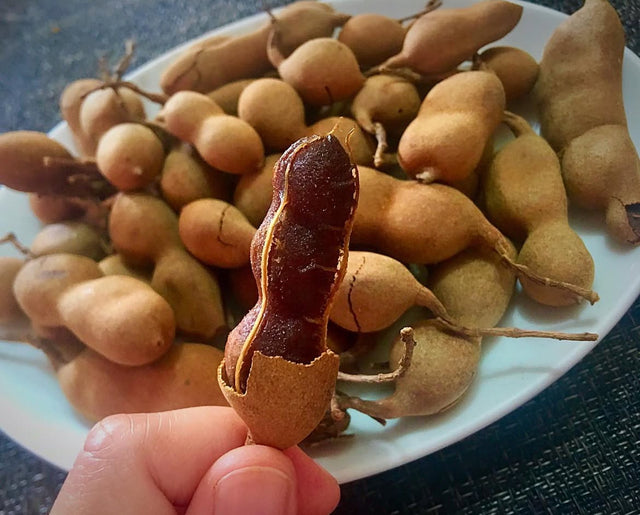
Tamarind is native to tropical Africa, where the fruits are consumed in a full spectrum of formats, from young and green to fully brown and mature. The tart leaves and flowers are also edible, traditionally eaten in salads or dipped in chili spice. Eaten green, the fruits are very tart, slightly juicy and akin to green mango. Eaten mature, the fruits range from sweet to tart (depending on variety). The exterior of mature fruits are brown and paper-y. This outer shell can be crunched and removed from the sticky flesh encased within. The brown mature flesh is sticky and surrounds a row of seeds. Tamarind seeds abound and have an exceptionally long shelf life.
Use the fruits’ paste for salsas, chutneys, sauces, cocktails, and candies. Dip young green fruits in chili sauce or a mix of salt and sugar.
Tamarind fruits can be harvested (tediously) by hand or the tree can be thrashed over a blanket or tarp to collect falling fruits. Fruits that mature in dry conditions are ideal. Mature fruits stored in dry conditions have a shelf life of months!
Tamarind trees can be propagated by seed, graft, or air layer. Our Sweet Tamarind Trees are grafted which guarantees a yield of deeply sweet fruits. Our stock of tart tamarind trees are grown from seed, making for a sturdy root system and trunk.
Plant your tamarind tree in full sun for best fruit yield. Tamarinds are resistant to branch breaking and are therefore ideal as central specimen trees or as mottled shade for an entire garden.
When choosing a location, consider tamarind trees’ aversion to wet feet and salty conditions. Their adaptation to Florida’s limestone rich soil makes for a low-maintenance option.
_________________________________________________________________
Size - 50’ Tall x 40’ Wide
Noteable Characteristics - Large and wind-resistant
Sunlight requirements - Full Sun
Cold hardy temp - 26 F for established trees; Young trees susceptible to frost damage
Harvest Season - February to May (often fruits out of season)